
Chapter 8 - The Geometry of the Notebooks of Leonardo da Vinci
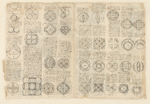
, , mercredi 17 mai 2023The IREM group in Limoges has immersed itself in “the geometry found in Leonardo da Vinci’s notebooks” to design teaching sessions throughout cycle 3 focused on constructing geometric figures and writing construction programs. Pupils, driven by great curiosity, explore Leonardo da Vinci’s notes preserved in the famous Codex Atlanticus as they attempt to uncover the secrets behind his constructions. The aim is to work with circles and squares by isolating elementary figures through the reasoned observation of complex shapes drawn during the Renaissance.
Example of an activity sheet designed for 10–11 year old students working in groups

Some references
Ackermann, J. S. (1998). Leonardo Da Vinci : Art in science. Daedalus, 127(1), 207–224.
Berthelot, R., & Salin, M.-H. (1998). The role of pupils’ spatial knowledge in the elementary teaching of geometry. In C. Mammana & V. Villani (Eds.), Perspectives on the Teaching Geometry for the 21 Century, an ICMI Study (pp. 71–77). Springer.
Berthelot, R., & Salin, M.-H. (2001). L’enseignement de la géométrie au début du collège. Comment concevoir le passage de la géométrie du constat à la géométrie déductive ? Petit x, 56, 5–34.
Denizeau, G. (2016). Léonard de Vinci : le génie visionnaire. Larousse
Duval, R., Godin, M., & Perrin-Glorian, M.-J. (2023). Reproduction de figures à l’école élémentaire. In C. Castela & C. Houdement (Eds.), Actes du séminaire national de didactique des mathématiques (pp. 5–89). ARDM, IREM de Paris 7.
Duvernoy, S. (2008). Leonardo and theoretical mathematics. Nexus Network Journal, 10(1), 39–49.
Isaacson, W. (2017). Leonardo da Vinci. Simon & Schuster.
Keskessa, B., Perrin-Glorian, M.-J., & Delplace, J.-R. (2007). Géométrie plane et figures au cycle 3. Une démarche pour élaborer des situations visant à favoriser une mobilité du regard sur des figures de géométrie. Grand N, 79, 33–60.
Marinoni, A. (1982). La matemática di Leonardo da Vinci : una nuova immagine dell’artista scienziato. Arcadia Edizion.
Ministère de l’Éducation nationale. (2015). Programme d’enseignement du cycle des approfondissements (cycle 4). Journal officiel du 24/11/15.
Moyon, M., & Plantevin, F. (2025). Teaching mathematics through historically-based activities : Two educational experiments. HISTEMAT. Revista De História Da Educação Matemática, 11.
Offre, B., Perrin-Glorian, M.-J., & Verbaere, O. (2006). Usage des instruments et des propriétés géométriques en fin de cm2. Petit x, 72, 6–39.
Perrin-Glorian, M.-J. (2008). Teach plane geometry in coherence from 6 to 15 years. Journal of Mathematics, Teaching and Culture–REMATEC, 48.
Perrin-Glorian, M.-J. & Mathé, A.-C. (2023). The geometry of tracing, a possible link between geometric drawing and Euclid’s geometry ? In C. Guille-Biel Winder & T. Assude (Eds.), Articulations between tangible space, graphical space and geometrical space : Resources, practices and training (pp. 3–34). Wiley-ISTE.
Perrin-Glorian, M.-J., Mathé, A.-C., & Leclercq, R. (2013). Comment peut-on penser la continuité de l’enseignement de la géométrie de 6 à 15 ans ? Le jeu sur les supports et les instruments. Repères-IREM, 90, 5–41.
Piumati, G. (1894–1904). Il Codice Atlantico di Leonardo da Vinci, in the Ambrosiana Library in Milan. Hoepli.
Dans la même rubrique :
- Chapitre 1 - Voyage en numération maya
- Chapitre 2 - De l’abaque à jetons au calcul posé
- Chapitre 3 - La mécanisation du calcul
- Chapitre 4 - Les rapports de nombres
- Chapitre 5 - Doubler le carré avec Platon
- Chapitre 6 - 1793, la révolution du temps
- Chapitre 7 - Et si nous mesurions la cour de l’école : expériences d’arpentage
- Chapitre 8 - La géométrie des carnets de Léonard de Vinci
- Chapitre 9 - Se protéger grâce aux mathématiques : la géométrie des fortifications
- Chapter 3 – The Mechanisation of Calculations
ADIREM
Les 28 IREM, IREMS, IREMI ou IREMIS sont organisés en un réseau national, l’assemblée des directeurs et directrices d’IREM (ADIREM), avec un comité scientifique (CS) et des (…)
Comité scientifique
Le rôle de cette instance s’ordonne autour de 3 axes : Veille et incitation, suivi des réalisations des IREM et accompagnement des actions de l’ADIREM. Le comité scientifique des IREM (…)
Commissions Inter-IREM
Les commissions inter-IREM (CII) sont des groupes de travail constitués de membres de différents IREM centrées sur un cycle d’études, un thème, une activité, une (…)
IREM - Instituts de recherche sur l’enseignement des mathématiques - 1977-2026 - Connexion